Friday, 22 February 2019

The Helmet of Skanderbeg


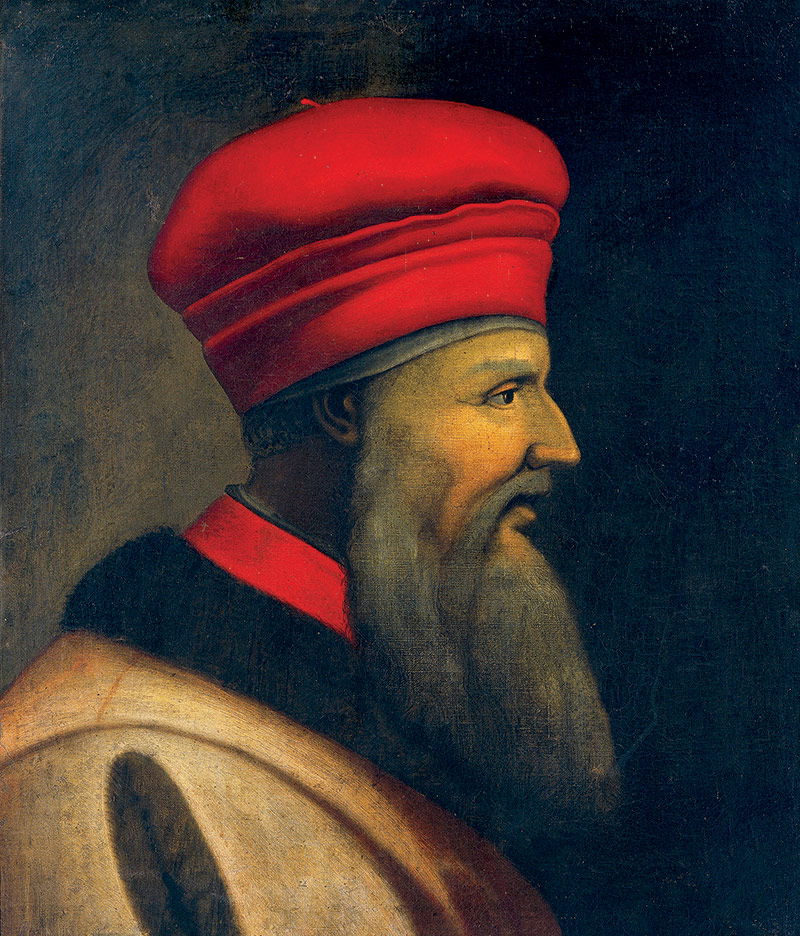
One of the most iconic pieces of armour from any era, but especially the 15th century, is the helmet of the Albanian national hero Skanderbeg. With its distinctive horned goats head it is a suitably unique piece for a one of a kind warrior. But why a goat's head?


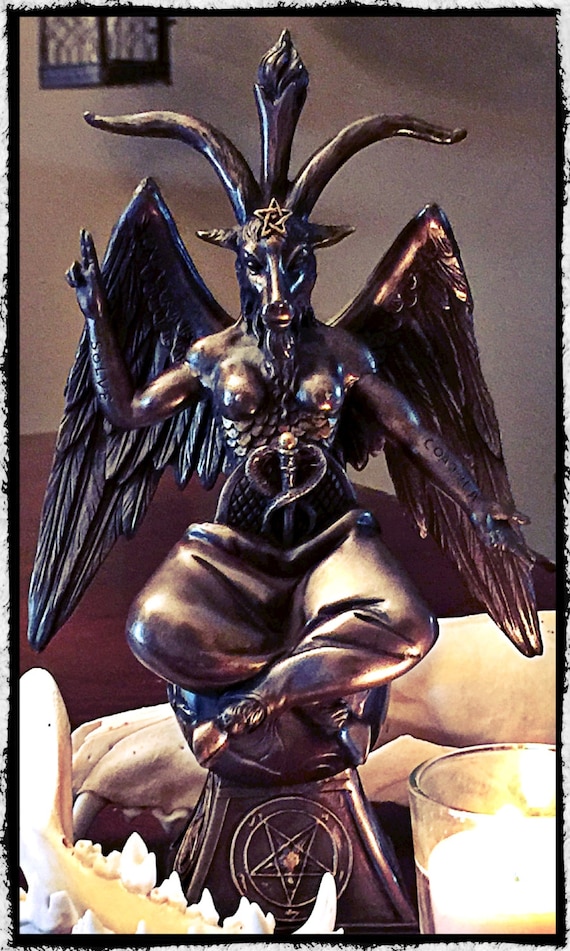
The first thought that comes into my mind is the demon Baphomet, the deity that the Knights Templar were falsely accused of worshipping in trial transcripts for the Inquisition of the Knights Templar starting in 1307. The name had come to Europe with the returning Crusaders but rather than being the goat-demon (that image is more of a 19th century invention) the original Baphomet = Mahomet, Muhammed. A chronicler of the First Crusade, Raymond of Aguilers, called the mosques Bafumarias. The templar trials essentially accused them of having secretly turned to the enemy religion.


Of course it's entirely coincidental, but Skanderbeg of the Baphomet horns was himself at one time a Muslim.


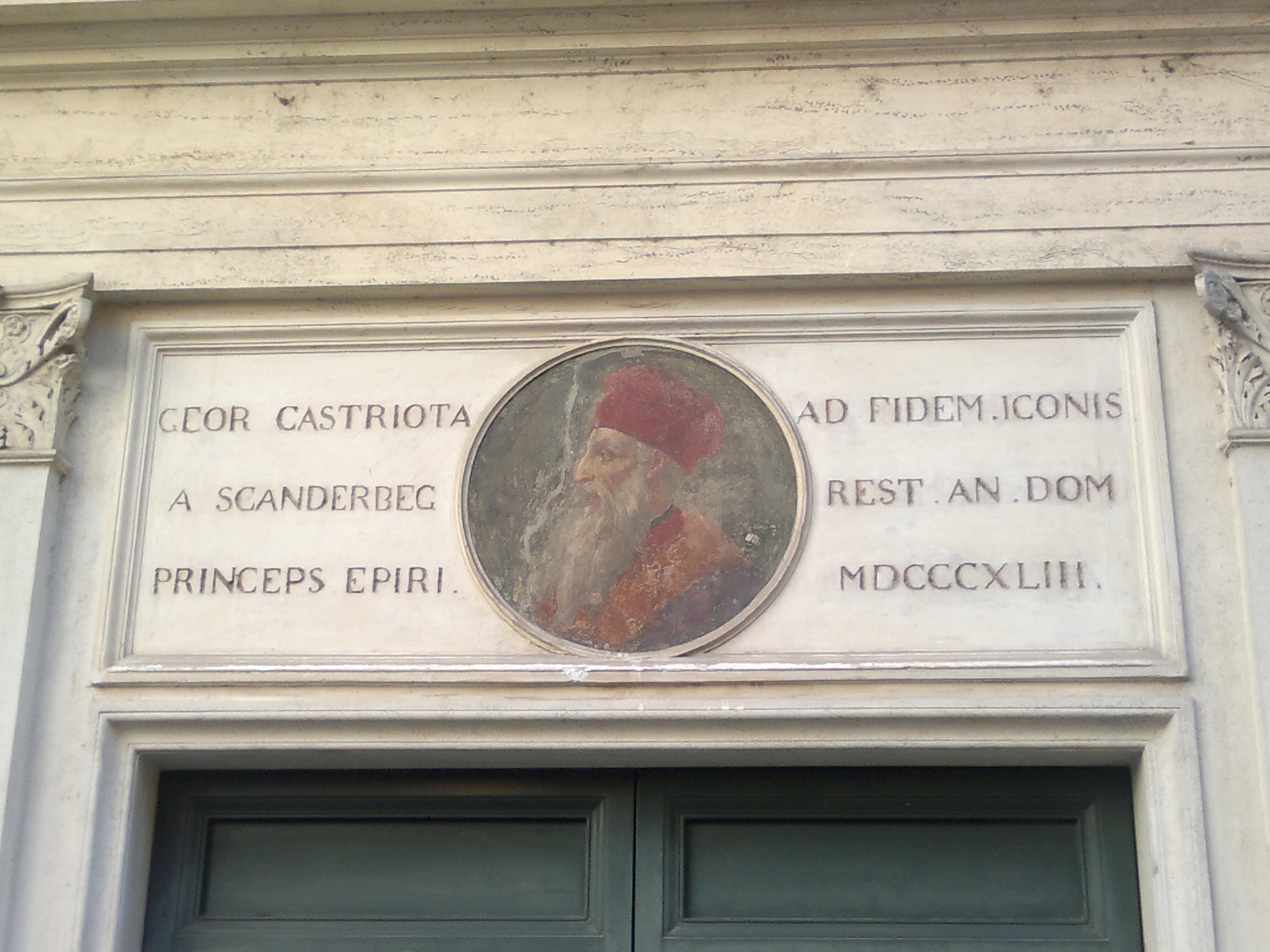
Gjergj Kastrioti was born into the noble Castriot family. As a child he was taken as part of the Devshirme 'child tax', converted to Islam and was raised at the Ottoman court, then served the Ottoman sultan for the next twenty years, risingto become sanjakbey (governor) of the Sanjak of Dibra in 1440. In 1443, he deserted the during the Battle of Niš and became the ruler of Krujë, Svetigrad, and Modrič. He returned to the Orthodox faith of his family and in 1444, he was appointed commander of the short-lived League of Lezhë. He consolidated power throughout his homeland and thus for the first time Albania was united under a single leader. 


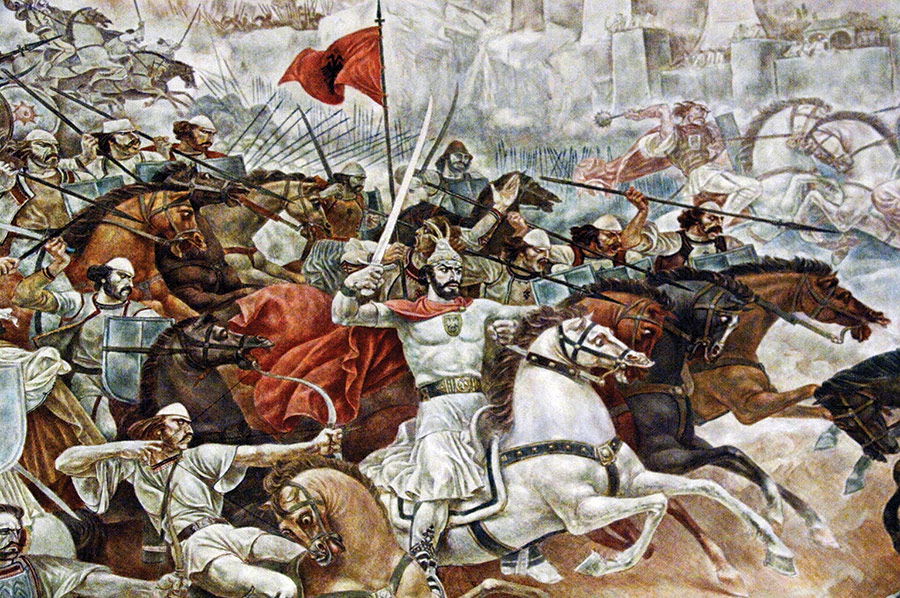
Inevitably the Turks did not take kindly to a turncoat. For 25 years, from 1443 to 1468, Skanderbeg's 10,000 man army held back repeated incursions into the Albanian mountains by much larger Turkish armies. 

In 1451, he recognized de jure the sovereignty of the Kingdom of Naples over Albania through the Treaty of Gaeta, to ensure a protective alliance, although he remained a de facto independent ruler. In 1460–61, he participated in Italy's civil wars in support of Ferdinand I of Naples. In 1463, he became the chief commander of the crusading forces of Pope Pius II, but the Pope died while the armies were still gathering. 


In late 1466, old and ill, he visited Rome to petition the new pontiff, Pope Paul II, for funds to continue his Ottoman resistance. He was given plenty of honours, including a sword which also survives to this day, but little hard currency (2,300 ducats). He commented bitterly that he should be fighting against the Church rather than the Ottomans and then headed south to Naples in early 1467 where his patron was only a little more generous. He returned home but died of malaria in January 1468 and with him effectively died Albania's resistance.


Returning to the iconic helmet and its horns. The best explanation I have comes from Skanderbeg's Islamic childhood. In Surah 18 verses 83-101 of the Quran, Dhul-Qarnayn, 'He of the two horns' is a heroic figure who builds a wall to hold back the monstrous giants, Gog and Magog. Is Skanderbeg's helmet a sly anti-Islamic joke in which he positions himself as Dhul-Qarnayn and implies the Muslim Turks are the giant threat to be held at bay?


Another layer to the reference is the fact that the Dhul-Qarnayn story supposedly entered the Quran from legends of Alexander the Great's exploits in the Middle east. Alexander, as depicted on his coins, wore the horns of the ram-god Zeus-Ammon. He was also (incorrectly) linked to the Sassanid walls in the Caspian Gates which held back the Scythian hordes. And if Dhul-Qarnayn, he of two-horns, is Alexander, it is an appropriate symbol for a man who chose Alexander (Skanderbeg) as his nom de guerre.


Thursday, 21 February 2019

Map of Constantinople, 1453 & Finding the house of Loukas Notaras


To orientate readers of Porphyry & Ash, I took the Cristoforo Buondelmonti map of Constantinople from 1420 & rejigged the key bits onto a more accurate land shape. As you can probably tell, this was a first foray into photoshop.


(Click to enlarge)

And here is the original by the Florentine cartographer Cristoforo Buondelmonti


Buondelmonti was an Italian Franciscan priest and traveler who left Tuscany in 1414 and traveled across Greece. His map is the oldest surviving of Constantinople, and the only one which antedates the Ottoman conquest of the city in 1453. They were much copied (the one above is actually one of the copies, made in 1491).

In another of the Buondelmonti sketches there is a building which is clearly not a church, with a wonderful belvedere tower on one side and the notation "palatium chir Luca". Is this the house of Loukas Notaras? It fits the rough location of where it should be found.


It also fits the rough location of Eirene Kulesi, the Tower of Eirene - a name given to it by a 16th century traveler. It formed a corner of the Valide Han in the Ottoman era but its Byzantine origin is unconfirmed. Might it have been part of the Notaras family residence?


Friday, 18 January 2019

Notaras Family Tree


George Notaras was father of Nicholas, who made the great fortune which waited in the vaults of St George in Genoa for his granddaughter to later claim.

Of note here is Theodorus Kantakouzene - Eudokia's father and Maria's husband who is the bridge linking the Notaras tree to the Kantakouzenos tree which contains Mara Brankovic.

Demetrios Laskaris Asan, brother-in-law of Loukas, was a bit of tyrant in the Morea (worthy of a blog post his own). He is almost certainly the same 'Uncle" who Helena sent off to ask Mehmed to intervene when Dorion Gattilusio tried to steal Ainos from her. Demetrios had by then sworn his allegiance to Mehmed.

Thursday, 17 January 2019

What really happened to Loukas Notaras?


One of the most famous incidents of the Fall of Constantinople is the fate of Loukas Notaras, the megas doux. Naturally the most lurid account has passed down in folk history. In this (pro-Greek) version, the sex-mad beastly Sultan lusts after the young son of Notaras, who refuses to hand him over and suffers Mehmed's wrath.

Other versions (including Edward Gibbons) focus on Notaras as a duplicitous traitor and Mehmed executing him for being untrustworthy (which would be a curious policy if the Sultan ever wanted to have foreign spies and agents in the future) or caught in some intrigue.

Theirry Ganchou, a Byzantine scholar at the Sorbonne has done magnificent work in this area. By looking at both Greek and Ottoman chroniclers of the time and cross referencing the diplomatic correspondence of Venice and Genoa, he has pieced together a picture of how what the governments of these Republics understood to be the situation on the ground in Constantinople evolved through the days and weeks of the summer of 1453.

I would certainly consider Ganchou's account to be most likely closest to the truth. What I think is interesting is that one can see within this version that both of the other two are not that far off reality in certain ways - in other words they are mutations of the truth to fit a bias, rather than total fabrications.

The certain facts of the matter are that Loukas Notaras was executed on 3rd June 1453. This means that he survived for four full days after the siege was ended. Every account indicates that his situation was not initially a dire one but that something happened that radically changed the Sultan's attitude towards him and he was then swiftly executed along with two sons and two sons-in law (then another 30 nobles the next day).

Ganchou holds that the accounts of Isidore of kiev, Kritoboulos of Imbros and Ekthesis Chronike are less polarised about what ook place and so perhaps more trustworthy than those of Niccolò Barbaro, Nikolaos Sékoundinos, Doukas or Chalkokondylès. From this he concludes the following course of events.

The day after the fall, Mehmed II was at first magnanimous. The high dignitaries and all other survivors who had been taken captive were scattered chaotically across the Turkish camp and ships. It was logical to methodically identify who they had taken (not least in order to arrange ransoms where prudent - particularly those citizens of other nations). Loukas Notaras, having been the man to formally surrender the city, was already identified. To facilitate the identification process, each dignitary found was invited to draw up a list of members of his family in order to be reunited with them. Doukas reports that it was Loukas Notaras who was charged with establishing these lists.
Mehmed's logic here appears to have been that by making advances to the former ruling class, he would reassure the Constantinopolitans so that they - having paid their ransoms - would not desert Constantinople en masse. To avoid such an exodus, he even entrusted to Loukas Notaras, the "first mediator" of the deceased basileus. This is very much in line with methods of conquest used elsewhere by the Ottomans. Theirs was not a conquest of decimation - like the Mongols - but an absorption of peoples.


Mehmed reportedly told the dignitaries that they were now "free", and allowed them to return to their homes. But then, sometime between 29th May and 3rd June, negotiations with Notaras broke down.
It seems that the intransigence of Notaras played a key part in the tragic final outcome. As a basis for their agreement, the Sultan demanded that as a token of his good faith, the megas doux consent to have his youngest son placed in his saray and here we have the origins of the salacious folk history of events.


In the circumstances, this demand by Mehmed is perfectly understandable. It was a prudent political tradition and many sons of vanquished had already become pupils of the Ottoman palace school before later resettling on their throne: the two most famous being Albania's Skanderbeg and both the sons of Vlad II of Wallachia. In other words, Mehmed's condition was a simple and very common, claim of a hostage. 

But these examples also would have showed Notaras that, while not inevitable, there was a great risk that the hostage would be forced to convert to Islam. In addition, this new requirement of the sultan could appear to the megas doux as an abuse of power in complete contradiction with its present situation. Mehmed had supposedly already liberated his family and so he should not now suddenly behave now to his sons as if they were children of slaves. Chalkokondyles reports that Notaras rebelled against this request by declaring that he did not understand what he had done to have imposed upon him now this vexatious measure. 

Faced with this impasse, and taking note of the hostile attitude of Notaras, Mehmed then ordered the execution of all high dignitaries and their adult sons. As for their wives, daughters, and those of their sons not older than adolescence, they fell into slavery, becoming the personal property of the Sultan.
An interesting note in Chalkokondylès's account states that Notaras requested his sons be beheaded first - so he would be sure they did not convert to Islam to escape their fate. This adds credence to the idea that the loss of his children to Islam was of significant concern to him. Secondly, Chalkokondyles says that the sons begged their father to tell the executioners that it was possible to have them deliver the wealth they possessed in Italy, so as not to be killed. Perhaps Loukas already had his daughters in mind when he chose not to do so.

And so it was that the two eldest sons of Loukas Notaras, along with the husbands of Maria and Theodora (Theodosos Kantakuzenos and Manuel Palaiolgos) were executed. And also that in the lamentable procession of the ladies of the aristocracy marching towards Adrianople on the 18th June, there were at least three widows: the wife of the megas Doux (who died on the march and was buried in what is now Kirklareli province in Turkish Thrace) and his two daughters, Theodora Palaiologina and Maria Kantakouzene. We might also conclude that either Maria was pregnant with Eudokia Kantakouzene or the child was among this group since her father had been executed and she later appears with her aunts in Italy). As for the young boy who had triggered the tragedy Jacob (Iakobos) was twelve years old at the time of the events. Separated from his sisters, he was destined for the personal service of the sovereign in his saray as a page, like many of the teenage sons of fallen dignitaries. We know that he escaped from the palace sometime around 1460 (aged 19) and made his way to Italy.

The first foreign embassy to the Sultan following the conquest was naturally enough the closest on the ground. It was weeks before news reached Italy but the Lord of Ainos, Palamedes Gattilusio, would have practically been able to see the fires of the siege from his battlements. Ainos (modern day Enez) sat on the Marmara coast at the mouth of the maritzsa river, the same river that wound past the Ottoman capital of Adrinople. A prudent man, he had stayed on good terms with both Byzantines and Ottomans and it would have been nothing but common sense to send congratulations to Mehmed as soon as news reached him of the fall. Kritoboulos of Imbros says the delegation from Palamedes Gattilusio arrived at Adrianople in June.


But Palamedes had another reason to begin speaking with the conquerors. His late eldest son, Giorgio, had married Helena Notaras, the oldest daughter of Loukas Notaras. At this time, it appears she was living with her father-in-law as the Great Lady of Ainos. We know from records that a daughter of the megas doux negotiated the release of the rest of the Notaras family while they were on their way to Adrianople (but not before the matriarch died in Thrace). This daughter is not identified - it might have been Anna, it might have been Helena or it might have been both (since Ganchou's hypothesis is that Anna had been sent to Ainos for her protection before the fall, not Italy).
Now the question arises - why were the Notaras daughter(s) able to ransom both Theodora and Maria but not Jacob? With Loukas Notaras dead, there was no value in him as a hostage. If we reject the idea that Mehmed was infatuated with the boy as a sex slave, we are left with the probability raised by Ganchou that the reason he could not be ransomed was that he had already converted to Islam. There is no documentary confirmation of this conversion and the fact of his escape and subsequent life in Italy speaks in the very least towards it being insincere if it took place at all. Whatever the situation, either Mehmed refused to give Jacob up or Helena did not attempt to purchase his freedom (perhaps on the incomplete information that the sons of Loukas Notaras had been executed).


Meanwhile, the Italian governments were buried under an avalanche of conflicting information about what had taken place. As late as August 16th 1453, the Genoese chancellor was writing to correspondents insisting that the extent of the eastern disaster had been exaggerated and gave as evidence the fact that the sultan had made wise use of his victory and reappointed Loukas Notaras in his position. This might be an understandable reading of events if the author of that report had fled the city sometime between 29th May and 3rd June. The Genoese were particularly interested to know the fate of the Megas Doux since they held in their possession a great fortune at the Bank of St George, which had been placed there by Nicholas Notaras - father of Loukas - many years previously and never touched by Loukas (perhaps because it was seen as emergency fund in case of just such a catastrophe).

On 17th July, Venice was still unaware of the execution of its bailo, Girolamo Minotto (executed on the 30th May). On that day, one of Minotto's sons was given permission to embark for Constantinople to seek his father's ransom. By the 28th August news had clarified and the Senate granted pensions to the widow and children of their bailo following Minotto's death.

Venice then dispatched her own delegation to negotiate a peace treaty with the Sultan. The ambassdor was Bartolomeo Marcello and he took with him the Greek-born Venetian diplomat Nicholas Sagundino (Nikolaos Sekoundinos). Their most likely route to Adrianople would have been to land at Ainos. It is possible that there they came across the released Notaras daughters - we do not know but what is certain is that Sagundino was sent back to Venice in November to relay the situation and he gave a speech to the Senate in December 1453 which focused very firmly on the fate of Loukas Notaras. It is from this speech that the salacious version of events originates. Sagundino chose to make Notaras the counter example of the vices of the young Sultan, contrasting the nobility and imperturbable moral rigor of the vanquished to the savage and barbarous victor. According to him, indeed, the end of the mags doux was worthy of both an ancient hero and a Christian martyr: images calculated to strike a chord with an audience full of Christian humanists. Sagundino therefore plays up the noble figure of a truly "Roman" father who, realizing that the Sultan's request to surrender his youngest son concealed only infamous designs, refuses to obey in the full knowledge that it will condemned both him and his son. He also juxtaposes the 'pure' love of a father for the immortal soul of his child against the 'impure' love of a sexual deviant.


In Sagundino's account, Notaras exhorts his sons to accept death with inspired words worthy of Plutarch or a martyr of the first centuries. The story told in this way also echoes that of Saint Pelagius, a thirteen-year-old Christian martyr in tenth century Spain who refused the sexual advances of a Cordoban caliph. And of course, such an echo from Iberia would be a hope-inducing reminder to Greeks of the Reconquista, at that time almost completed.

Such was his eloquance that Sagundino was sent on by the Senate to repeat his performance to the Pope and King of Naples (which he duly did on December 27th and January 24th respectively). In March 1454, Genoa gave instruction to its ambassadors to Adrianople, Baldassare Marruffo and Luciano Spinola to inquire about the fate of the son and two daughters of Loukas Notaras who were said to be prisoners. In the event neither man arrived in Adrianople - one died on route, the other refused to go further than Chios out of fear.

The Notaras case therefore gained a certain amount of fame on the Italian peninsular and led to more than one creditor emerging who tried to obtain payment from the assets frozen in the Bank of St George. The resolution of who should inherit this fortune was a long and tangled affair (with the only surviving male heir being dismissed by Italian authorities on the grounds of his conversion to Islam). We know that Maria and Theodora were ransomed for 700 ducats (a much higher sum than other Constantinopolitans were freed for) and that obtaining the funds for this was very much bound up in the issue of the frozen assets.

Saturday, 12 January 2019

Un-Boxing Helena


        Sometimes scattered pieces of historical information fit together to form a picture of the past which, whilst not definitive, appears plausible. Such is the case of Helena Notaras, the elder sister of Anna Notaras.


        As so often with non-royal women of the past, what little information was recorded of their lives comes as a side-note or afterthought in documents focused on the men around them. It is therefore a matter of collecting up these fragments and puzzling out the mosaic of a life from among them.

      Loukas Notaras was among the wealthiest (if not the richest) man in mid-15th century Constantinople, holder of several important court functions, in 1441 he sailed with George Sphrantzes and the Despot of the Morea (the future emperor Constantine XI) to Mytilene on Lesbos where Constantine married the daughter of the Lord of Lesbos, Dorino Gattilusio. The Gattilusio family, originally from Genoa, had been lords of Lesbos and the Cyclades archipelago for a century and had followed a policy of prudent integration with both their Ottoman and Byzantine neighbours: Dorino's aunt, Irene, had married the Byzantine Empeor John VII Palaiologos.

       It would appear that Notaras took the opportunity to link his own family to a royal occasion by arranging the wedding festivities to be a double union. As well as Caterina Gattilusio's marriage to Constantine, Dorino's nephew, (Giorgio Gattilusio) took the hand of the eldest daughter of Loukas Notaras in 1441. Helena.

       This was a prudent choice. For whilst Dorino Gattilusio ruled Lesbos, his brother Palamedes was ruler of Ainos (modern day Enez), a small city on the Thracian peninsula and Giorgio was his father's heir. [It's a measure of the inter-related nature of medieval aristocracy that two of Giorgio's sisters married Campofregoso brothers, both of whom served as doge of Genoa in their time]. The Notaras were a merchant family, originally from Monemvasia with estates in the Morea, Kythera & strong links to Genoese merchant familes including the Gritti and Lomellini, so a marital link into the Genoese Gattilusio was likely as much about business as imperial prestige. Loukas Notaras's father Nicholas had obtained Genoese citizenship in the 1390s while negotiating grain contracts on behalf of the emperor John VII.

        Both Helena & Constantine's marriages to the Gattilusio cousins were tragically short lived. A year after the wedding festivities, while travelling from the Morea, Constantine's ships ran into a Turkish pirate fleet and took shelter on Lemnos. There Caterina died of complications from a miscarriage. It was the second time Constantine had been widowed in this way. He never married again.

        Helena's husband Giorgio also died young, in 1449. By then, Helena had born him at least two children. We don't know if Helena and the children remained living with Palamedes Gattilusio in Ainos at this time but it's clear Helena did not give up her interest in her husband's estate. The Gattilusi of Ainos paid a tribute to the Ottoman Sultans and Mehmed's army left the city unmolested on its march to Constantinople.

       The Lord of Ainos was the first to pay respects to Mehmed as the new ruler of Constantinople and it seems that at this point Helena began to try and negotiate the ransom of her two sisters (her mother having died on the march to Adrianople). If she tried to also obtain her brother Jacob's freedom at this time it was impossible - since he had converted to Islam and joined the Sultan's palace school as a page.

      The ransom negotations for Theodora and Maria Notaras were prolonged - it took almost two years to be completed - and complicated by a legal question which arose in Italy over what should happen to the vast Notaras family fortune which was frozen in the Bank of St George in Genoa. That issue was not fully resolved until 1459, but in the meantime the ransom of the girls was set at 700 ducats - by far the highest ransom rate of any recorded among abductees of the fall. This as much as anything shows the status of the Notaras family at this time as second in social rank only to the imperial family of the Palaiologoi.

      Meanwhile in Ainos, two years after the fall, Palamedes Gattilusio himself died at the age of c.65 year old (perhaps at shock from the ransom his daughter-in-law was seeking to pay!). With Giorgio long since dead, the title of Lord of Ainos by rights should have passed to any son Helena had born. Instead, Giorgio's brother Dorino claimed the lordship. We might assume that one of Helena's children was indeed a boy, because in late 1455 she appealed to the sultan for him as suzerain of Ainos, to uphold her child's inheritance rights. An unnamed uncle was dispatched to petition the Ottoman court.

       Dorino Gattilusio's brief rein over Ainos does not seem to have been a happy one. Turkish records indicate that Helena's was not the only complaint which had been raised against him and judges from local Turkish towns had also blackened his name. Whether it was in response to this or not, we know that a squadron of 10 ships under Yunus Pasha set out from Constantinople and bore down upon Ainos on 25th January 1456 [It's not clear if this is the same man as 'Yunus Bey' aka Thomas Katabolenos, Greek secretary to the Sultan who would be killed in the failed ambushing of Vlad Dracula in 1461].

Gates of Ainos

         Dorino had the good fortune to be out when the long arm of Turkish justice came knocking that January. He was on Samothrace, another of the islands under Gattilusio control. The people of Ainos opened the gates to Yunus Pasha without contest and the town fell under Turkish control and remains so to this day. What happened to Dorino is a story for another day.


          Governorship of the town was given to Demetrios Palaiologos in 1463 when the Morea was conquered but it appears to never have been handed over to Helena Notaras or her son. Instead Helena vanished from historical sight in 1456 until we see her mentioned in the last will and testimony of her younger sister Anna and even then it is a posthumous reference. By 1493 it appears that Helena had taken the monastic name of Euphrosyne and subsequently died but we have dates for neither. We also have no certainty over whether she joined Theodora and Anna in Italy or what happened to her children. One possibility is that in 1456 they joined their young uncle Jacob in the Ottoman palace school and grew up as Janissary as many of the children of fallen Constantinople did (the siege of Malta in 1480 was commanded by Mesih Pasha, a young scion of the imperial Palaiologoi who had been ten at the time of the fall).


       Euphrosyne, Goddess of Joy and Mirth, was the name Helena chose to take in later life (although she probably had St Euphrosyne of Alexandria in mind)


The mystery of Helena's life between Girogio's death and her death as the nun 'Euphrosyne' will likely never be fully resolved. But following the strands along their lines of possible continuation are a good measure of how inter-connected the aristocratic families of Genoa, Serbia, Byzantium and even the Ottomans were at this time.


Saturday, 22 December 2018

Benozzo Gozzoli's Byzantine-Florentine Advent Calendar (part 5)


Continuing on from my previous posts on Benozzo Gozzoli's masterpiece "The Journey of the Magi". This time, I would like to focus on the gaggle of Italians to the far right of the procession...


The Italians


Ahead of the old king’s retinue, the crowd of onlookers is made up of Medici Bank managers including Diotisalvi Neroni, Luca Pitti, Bernardo Giugni, Roberto Martelli, Francesco Sassetti and Agnaldo Tani. Although these men had already been key lieutenants of Cosimo de Medici over the years, several would turn on his son Piero once the family patriarch was dead. In 1466, Neroni and Pitti plotted a coup with Angelo Acciajuoli (of the famous Florentine-Athenian family) against Piero. It failed, and the plotters were forced into exile. 

Diotisalvi Neroni


Shorn of capable hands, the fortunes of the Medici bank began to turn downward. Francesco Sassetti became more influential and appears to have taken less care in monitoring the branch managers of the bank. In particular, the Bruge branch manager, Tommaso Portinari, was an accident waiting to happen. 

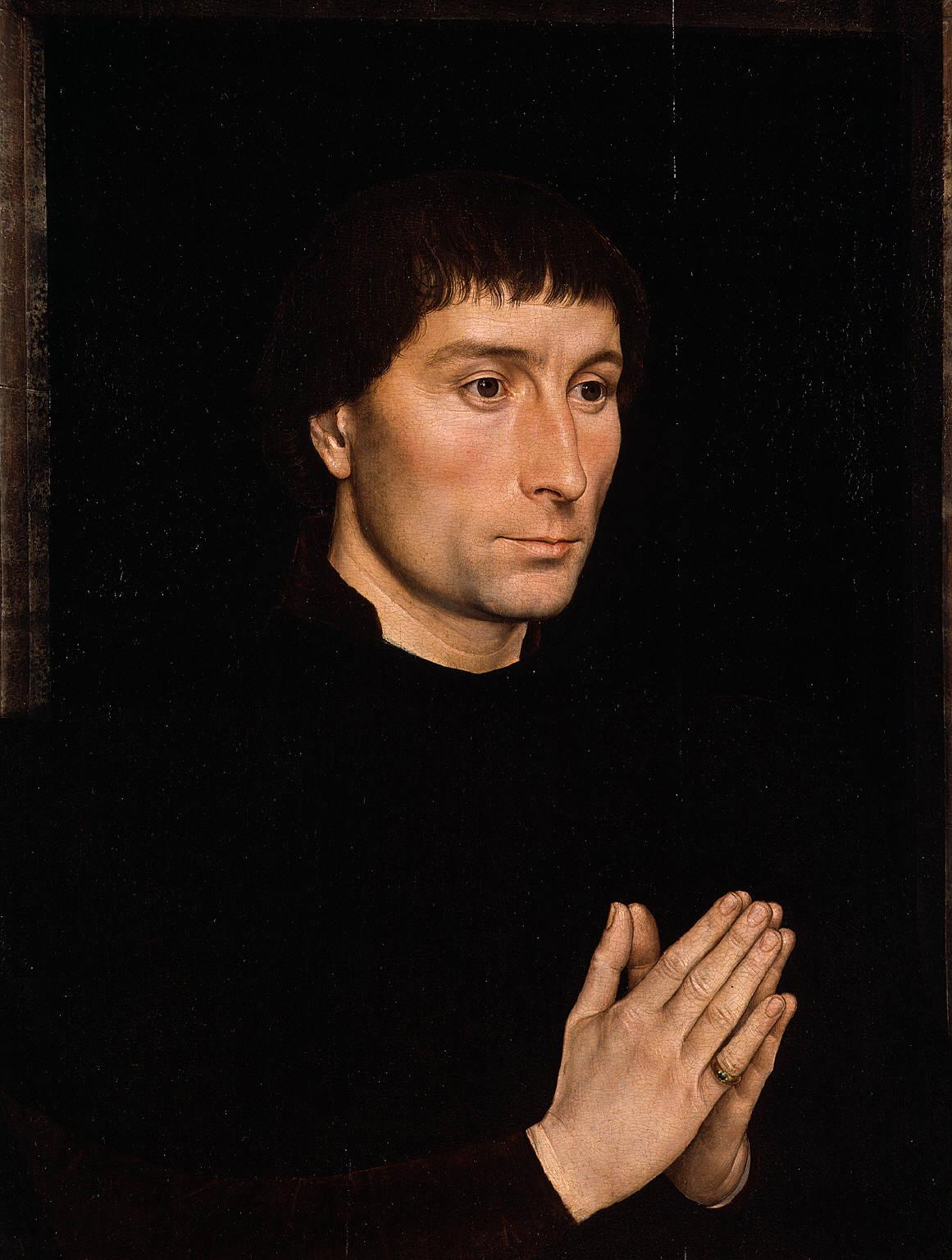
Tommaso Portarini

Cosimo had never trusted him and prevented his rise above assistant manager but when his influence was removed, Sassetti promoted Portinari to general manager and later removed the ban on lending to secular offices – a sequence of events which led to the reckless lending of vast sums to the Charles the Bold of Burgundy. Too bold, Charles overplayed his hand and died in the snow outside Nancy in 1477, sending a huge bad debt onto the Medici account books that forced the Bruge branch to be dissolved and began a slow collapse of the Medici bank under Lorenzo’s profligate stewardship.

Down in the bottom corner of this gaggle of Italian bankers is Cyriaco of Ancona, known as the father of archaeology. 


The young scion of an Ancona trading family, Cyriaco became fascinated by the ruins of antiquity he saw as he toured the Eastern Mediterranean exporting mastic gum from Chios. He was blessed with the most fascinating of lives - He knew absolutely everybody: He went hunting with King James of Cyprus, attended the Council of Florence where he met Sigismund Malatesta, Plethon, Emperor John, Cosimo de'Medici, Filelfo, and just about everyone else. Having consulted for the Turks during the 1422 siege of Constantinople had gained a pass from Sultan Murad to travel anywhere in his dominions "without vexation, taxation or any other injury." He corresponded with Emperor John VIII, stayed with Constantine Palaiologos in Mystra and went to the races with him there. He discussed history and philosophy with Plethon and the Union of the Churches and crusading with Pope Eugenius IV. When the Holy Roman Emperor, Sigismund, visited Rome he took Cyriaco as his tour guide among the ruins. In Florence, Brunelleschi explained to him his dome as it began to take shape and define the city skyline. The Marquis of d'Este invited him to Ferrara to see his newly-acquired "Entombment of Christ" by Rogier van der Weyden. He travelled with Memnon Tocco, bastard son of the Duke of Kephalonia, all over Anatolia and Thrace to spy on the Turk defences, and then all over the Morea to seek out antiquities. He sketched the column of Justinian in Constantinople – perhaps the last surviving record of that great marvel before it was toppled by the conquerors. He received Venetian citizenship in 1454 aged 62 – which is about the last record of his incredible life. He died peacefully in Cremona, probably in 1455.

Benozzo Gozzoli's Byzantine-Florentine Advent Calendar (Part 4)


Continuing on from my previous posts on Benozzo Gozzoli's masterpiece "The Journey of the Magi". This time, I would like to focus on the Renaissance scholars and humanists included in the entourage behind the Medicis...


The Greeks
In the left-hand crowd of Gozzoli’s masterpiece we find the true wise men of the painting. Most of the recognisable figures are members of the Byzantine delegation from the council of Florence: Bessarion, Gaza, Isidore of Kiev, Argyropoulos and Plethon and mingled with them are some Italians who drank in their teachings: the Pulci brothers, Marcilio Ficino and Enea Piccolomini (Pope Pius). 


Ficino, who was commissioned by Cosimo to make the first translation of Plato from Greek into Latin, stands to the right of Plethon, the man whose lectures at Florence mark the return of Plato into the western philosophical consciousness. 


Just above Pleton’s magnificently exotic hat is the bearded face of Ioannis Argyropoulos, who returned to Italy after the Fall of Constantinople to teach Platonic philosophy at the university of Florence (Ficino was his pupil).


At the far end of Plethon’s row is the low bearded face of Theodoros Gaza. He had moved to Italy earlier, following his native Thessaloniki’s fall and was took part in the council of Florence before making a career in Rome. Like many exiles of Byzantium, in 1459 he was part of Bessarion’s retinue.


Bessarion himself is the other bookend to this eminent row and he has a rather splendid (and I think significant) hat. It appears to be a skiadion, a tall, melon-shaped hat of a type which John VIII had worn in Italy and which several artists copied into their work. Bessarion’s hat is decorated with a thistle pattern. 

The Italian word for thistle is ‘cardo’. The same word in Latin means ‘hinge’ and is the root word of Cardinal. In 1459, Bessarion – who had come to Italy in 1439 as a Byzantine monk among the Greek delegation - was probably the most significant Cardinal of the Latin church and the real impetus behind Mantua’s call for crusade for Constantinople. I think Gozzoli has chosen the hat and the thistle symbol to mark out Bessarion’s duality as the Greek-Cardinal.

Interestingly there is a similar hat with the thistle emblem further back in the crowd. If there is a code to be drawn from the ‘red hats for Italians, exotic for foreigners’ and the ‘cardo for Cardinal’, then this figure must be a non-Italian humanist cardinal, probably linked in someway to the Council of Florence. The figure who would fit that bill would be Nicholas of Cusa.


Pope Pius was at the Council of Florence as Cardinal Piccolomini, although he did not play a prominent role. When Callixtus died in 1458, Bessarion was favourite to become Pope but his Byzantine heritage appears to have weighed heavily against him (not for the last time) and Piccolomini took the triple tiara. It was the second time Bessarion was frustrated in a conclave and there would be two more disappointments to come but in Pope Pius, Bessarion at least had an ally for his campaign to reclaim Constantinople which began with the Mantua council and ended, sadly with Pius’s death at Ancona as he waited for the crusading fleet to assemble.


When the delegation returned from Florence to Constantinople, a change of heart came over many of the Greeks who had agreed to the church union. Some, such as Gennadios, became violently opposed to the measure. The new patriarch, Metrophanes, found the mob had dubbed him “mother-killer” for signing the union. Still, Florence did engender a crusade of sorts. Bessarion had read the act from the Cathedral pulpit in Greek and Cardinal Cessarini read it in Latin. But six years later Cessarini was dead in the swamps outside Varna and the crusade collapsed in disastrous defeat without achieving any sort of victory against the Turks. The Union, always unpopular, then looked utterly pointless and the Greeks quietly pretended they had never signed it. So when their situation grew even bleaker and Constantine once again appealed for help, the Latin prelates wanted something more concrete than a shaky signature to seal the bargain. 


A cardinal was dispatched to ordain Hagia Sophia into the Latin church. The man given the task, Isidore, had come to the Council of Florence as a Greek monk but, just like Bessarion, remained there to become a Latin cardinal. He seems to have been given all the tough assignments – firstly dispatched to Moscow to persuade the Rus to accept the union. They declined and imprisoned him for two years before he escaped to Lithuania and back to Rome. Then a decade later he was given the task of consecrating Hagia Sophia. He survived the siege, having the presence of mind to switch his Cardinal’s robes with a corpse as the city fell and later escaped slavery to return to once again to Rome.